
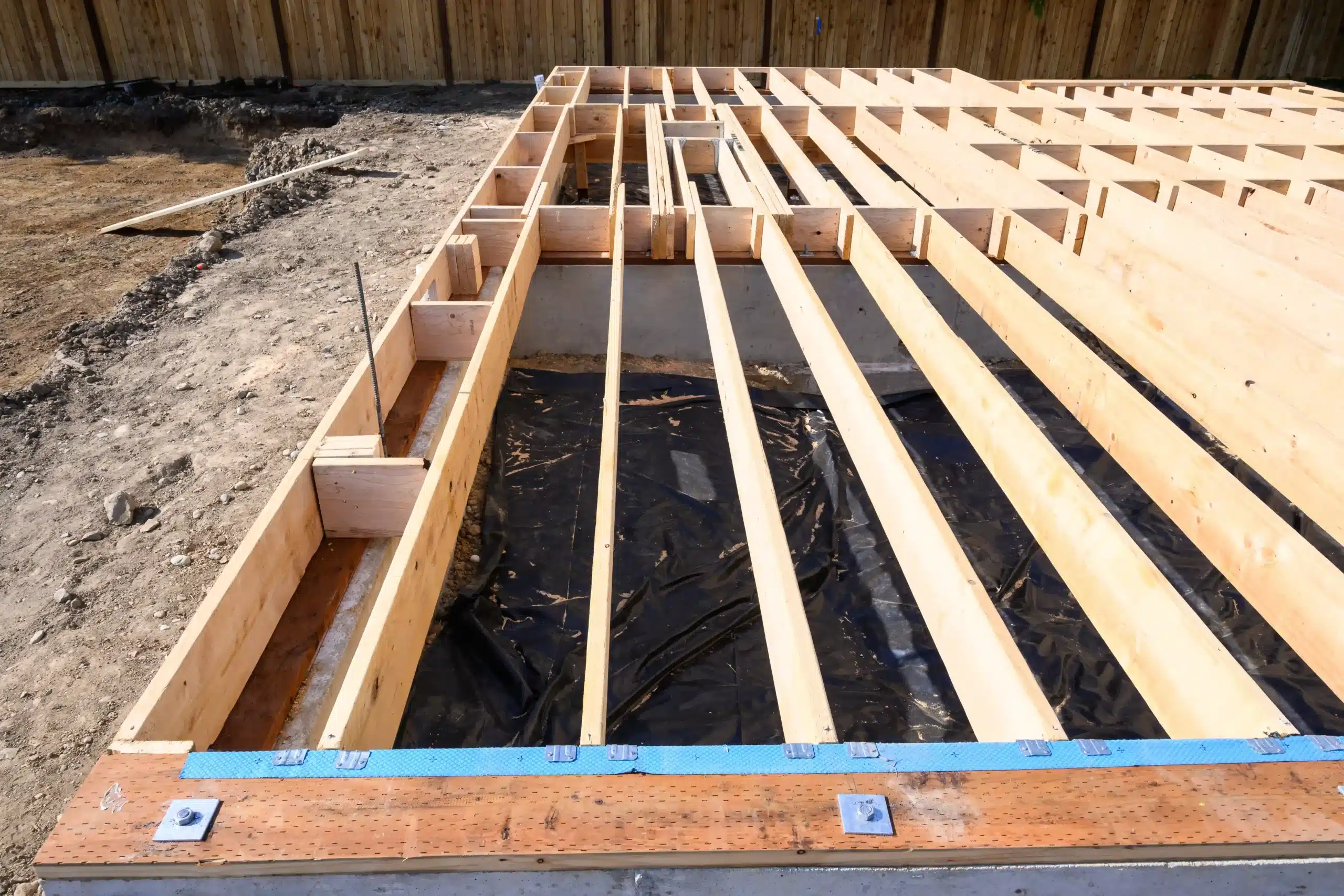
Floor joists are horizontal support beams that form the base structure of your floor system. These structural pieces sit beneath your flooring and spread weight evenly across the foundation by connecting load-bearing walls or support beams. Without them, floors wouldn’t be able to safely hold the combined weight of building materials, household items, and the people living in the space.
Types of Floor Joists
Floor joists come in different types based on their construction. In traditional timber homes, single-set joists support both the floor above and the ceiling below with a single framework. Double-set systems separate these jobs with different joist layers for each surface.
Joists can also be categorized by construction, with three common options: Solid lumber joists, which are thick wooden planks spanning between supports; I-joists, which have a thin center panel with wider pieces on top and bottom forming an I shape; and open-web trusses, which use metal connectors linking angled supports between two horizontal beams.
How Do Floor Joists Work?
Floor joists distribute weight by creating opposing forces within the beam itself. While one end pushes down, the top edge compresses and the bottom edge stretches, giving the joist strength to hold everything up. Spacing joists 16 inches apart distributes the load evenly across the floor, including from the structure and from anything placed on it. The joists then transfer the collected load sideways to walls or beams that carry it down to the foundation.
Why Do Floor Joists Matter?
Floor joists prevent floors from sagging and keep buildings structurally sound. They connect different parts of the framework so everything stays aligned as the structure ages. Damaged joists cause sloping floors, sticking doors, and serious safety issues that require major repairs.